







What Is a Die Tool?
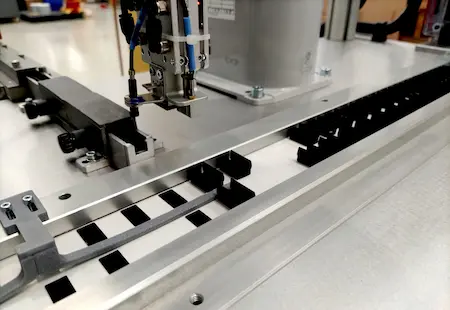
A die is nothing more than a mold created to cut adhesive tapes during mass production. The dies are used for large productions or, in general, for all those mass processing that would not be achievable with typical tools used for prototyping.
This tool can trim the roll, cut it, or give it a precise shape defined by a technical drawing.
Flat Die
It is a mold consisting of a rigid base (in wood or plastic) on which the blades are mounted. The die moves up and down on the material. Moreover, the sharpening of the blades allows blanking thanks to the pressure exerted during the downward movement.
Flat dies are perfect for small and medium productions, as well as for very large blanks (its working surface can exceed two meters). The height of the blades can also be very high, so it is also suitable for processing foam materials, as well as common adhesives.
In addition, flat dies have the advantage of being quicker to build and cheaper than rotary tools. However, they wear out faster and cut pieces more slowly.
Rotary Die
A rotary die is a metal cylinder on which the blades are welded. Thanks to a continuous rotary movement and the right pressure, the blades on the cylinder can cut the adhesive.
The wear times of rotary dies are longer than those of a flat die, and the speed of execution is considerably higher. Therefore, rotary dies are perfect for large productions.
Among the disadvantages, we find quite long construction times, higher costs, limited blade height, and reduced working width compared to flat dies.
Choosing the Right Die
During the design phase of mass production, the tool is defined. In some cases, the choice is “forced”: for example, a very large die-cut will certainly be produced with a flat die. Conversely, a small die-cut, of which millions of pieces are needed, will be produced with a rotary die.
However, this choice is not always that simple.
Sometimes, production batches are neither so low as to be produced using a flat die nor so high as to justify purchasing a rotary cylinder. The biggest problem is the cost of the die, which is not amortized by the number of pieces.
Especially when the value of the single piece is not very high, it becomes very difficult to get the customer to accept a significant initial outlay such as that of the construction of a rotary cylinder.
Is There a Solution? Yes: THE FLEXIBLE DIE

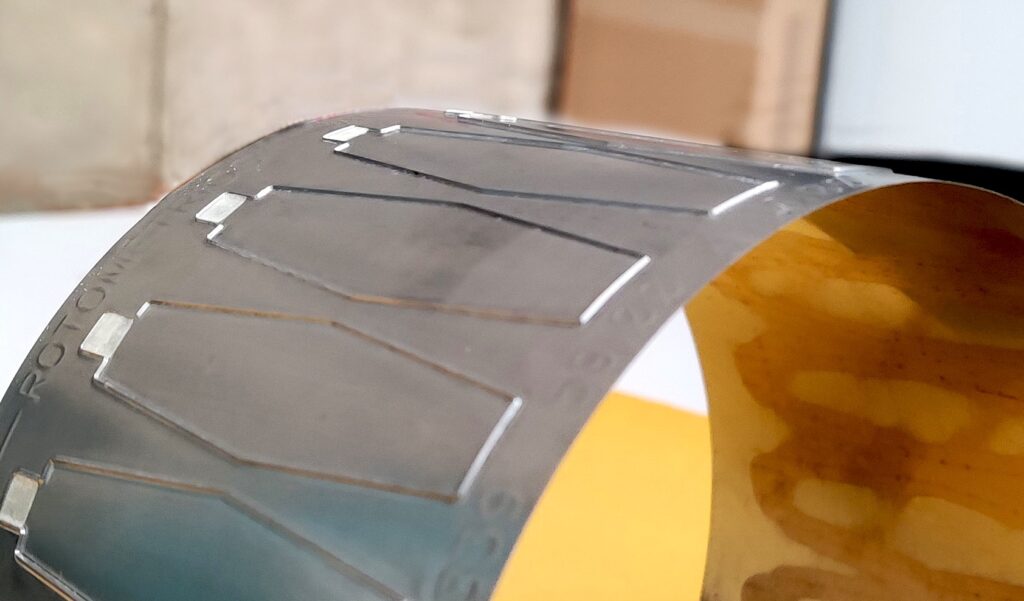
The flexible die cutting tools is a metal sleeve on which blades are fixed. This sleeve is very thin, produced in a short time, and is quite cheap.
The laminations are assembled by wrapping them on the so-called “magnetic cylinders,” tools very similar to a rotary die, available in various diameters, which can accommodate different sleeve sizes.
Thanks to flexible dies, it is possible to have performances almost identical to those of a rotary die but with the same (or lower) costs as flat dies.
Moreover, flexible die cutting allow taking on medium productions at significantly reduced costs, with reduced production times. This guarantees the end customer more competitive prices.
But be careful!
Even the flexible dies have limitations: just like for rotary dies, the height of the blades is limited, this makes them more suitable for processing thin one-sided and double-sided adhesives than foam ones; furthermore, the blades of the laminations wear out more easily than those of a rotary die and must be replaced more often.
The Technical Department, during the preliminary analysis, establishes which tool to use to optimize production and guarantee the customer maximum efficiency with the lowest costs.
Discover all our services.
BMP Team